
Effingham County Court Records After Arrest
After an arrest in Effingham County, the first public record may be a jail booking entry. That roster entry can show the arrest agency, booking number, charges, OTN number, bond rows, detainers, and sometimes a court tab. The formal court record is different. It is maintained through the Effingham County Clerk of Superior Court and the Tyler CM Web Search system, where the case can show filed charges, hearings, filings, dispositions, and document images when access rules allow.
The booking side and court side should be compared, not merged. Use Effingham County jail inmate records for current custody and booking fields. Use Effingham County jail mugshots for booking-photo access rules. Use the Clerk search when the question is what charges were filed after the arrest, whether a case is active or inactive, and what hearings or dispositions are tied to the case.
Search Court Records After Arrest
The court search path starts at the Effingham Clerk case-management page and continues to Tyler CM Web Search. The portal allows guest access, account login, and account creation. Guest users can search by party, associated party, or case number. The Clerk warns that users should try spelling variations and that court images or approved account features can have extra access rules.
- Open Tyler CM Web Search and choose Continue as Guest if no account is needed.
- Use Search By Party for a defendant name, entered last name followed by first name.
- Use Search By Case Number when the court code, year, and case number are known.
- Open the result and compare the filed charge list with the jail roster charge row.
- Contact the Clerk when an image, certified copy, older record, or restricted record is not available online.
The Tyler guest entry page is the public portal doorway for Effingham County court records after an arrest.
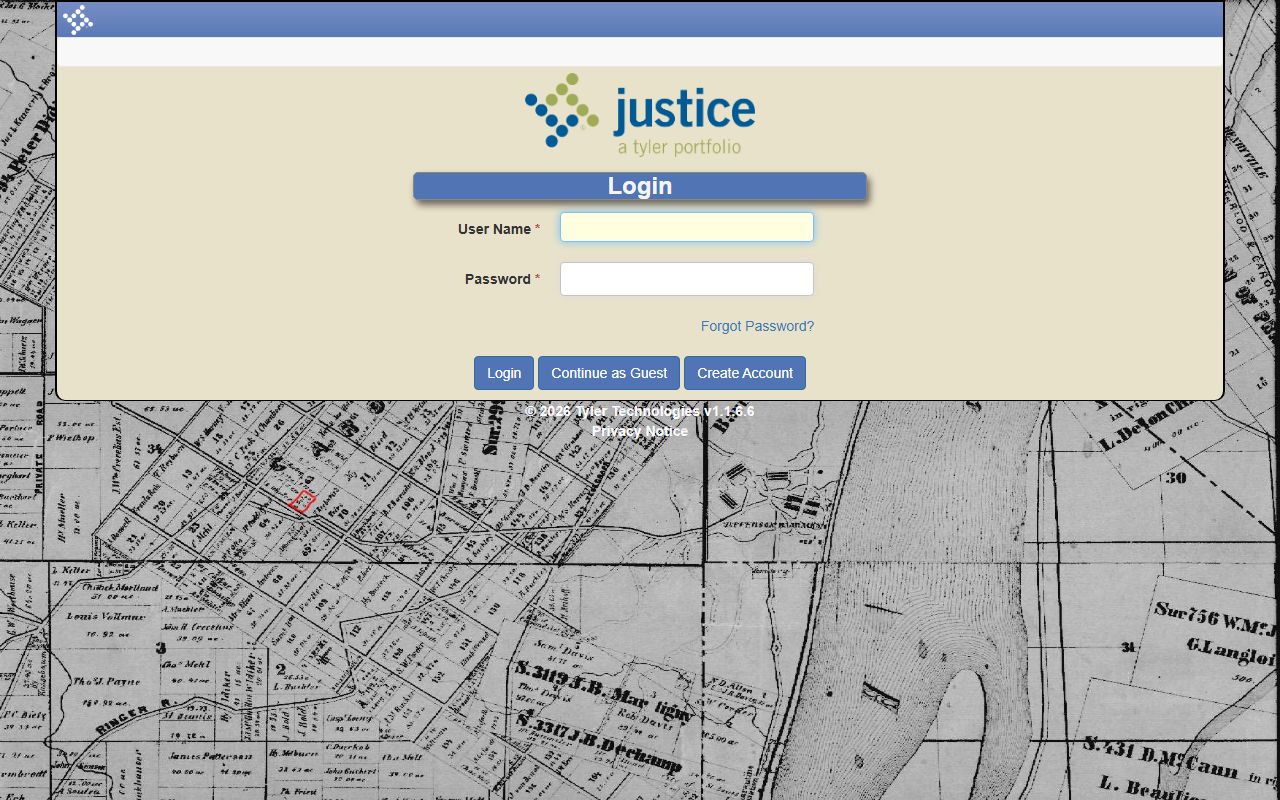
The guest entry matters because many court lookups can begin without an account, while images and clean copies may still require Clerk approval or payment.
Effingham County Court Search Fields
Effingham County court records after a jail arrest can be found by several search modes. Party search is best when only the defendant name is known. Case-number search is best when the roster or court paperwork has a case number. Court Code filters include ST for Effingham County State Court and SU for Effingham County Superior Court. Optional filters can narrow filing date and active or inactive status.
| Search Mode | Field | Required | Notes |
|---|---|---|---|
| Login page | Continue as Guest | n/a | Guest access path for public search. |
| Search by Party | Party Name | Yes | Last name followed by first name, no suffix, minimum 2 letters. |
| Search by Party | Court Code | Optional | ST for State Court, SU for Superior Court. |
| Search by Party | Filing Date From / To | Optional | MM/DD/YYYY date mask. |
| Search by Party | Case Status | Optional | All, active, or inactive. |
| Search by Case Number | Year | Yes | Four digits; system validates against current year. |
| Search by Case Number | Case Number | Yes | Up to six digits, padded in the system. |
Charges Filed After Jail Arrest
The arrest-to-court path usually starts with a law-enforcement charge and jail booking. The prosecutor then reviews reports, evidence, warrants, and bond status before deciding what charges to file or pursue. In Effingham County felony and circuit prosecutions fall in the Ogeechee Judicial Circuit. Formal charging can use different instruments depending on the case type and court stage.
| Charging Document | Who Uses It | Plain Meaning |
|---|---|---|
| Complaint | Officer, court, or prosecutor depending on stage | Initial sworn charge or allegation that can begin the court path. |
| Accusation / Information | Prosecutor | Formal prosecutor-filed charge used for many non-indicted cases. |
| Indictment | Grand jury through prosecutor presentation | Formal felony charging document returned by a grand jury. |
Official county and circuit pages still listed Robert Busbee as District Attorney during the June 4, 2026 research, while current reports after his May 22, 2026 death said Chief Assistant District Attorney Jillian Gibson was acting DA pending appointment. For filings, use the office and court record rather than an outdated name alone.
Charge Status in Court Records
A roster charge can change after prosecutor review. Charges may be amended, reduced, added, dismissed, nolle prossed, or resolved by plea or trial. That is why Effingham County court records after a jail arrest should be checked in the Clerk system even when the jail roster still shows a charge row. The court status is the better source for the current legal stage of the case.
| Status | What It Means |
|---|---|
| Pending | The charge or case remains open, and no final disposition has been entered. |
| Amended / Reduced | The prosecutor or court changed the charge from the booking version. |
| Dismissed | The charge was ended by the court or prosecution without conviction on that count. |
| Nolle Prosequi | The prosecutor chose not to continue that charge, often shown as nolle prossed. |
| Convicted / Guilty | A plea or verdict resulted in a conviction, which is different from a mere charge. |
Bond Records After Arrest
Bond information can appear in more than one place. The jail roster may show bond type, amount, agency, and status. The court record can show bond hearings, orders, amended conditions, or no-bond decisions. Effingham's online bond page says online credit-card bond is treated as a cash bond returned to the arrestee after case resolution. If the payer wants the bond returnable to the payer as surety, the payer must appear in person at the jail and complete the required paperwork before release.
| Bond Type | How It Works |
|---|---|
| Cash bond | Money paid directly; Effingham online cash bond returns to the arrestee after case resolution. |
| Surety bond | A surety arrangement; the payer must appear in person for Effingham returnable-to-payer paperwork. |
| PR / unsecured release | Release on promise or unsecured terms only where Georgia law and the court allow it. |
| No-bond hold | The person cannot be released by simply paying money on that charge at that stage. |
| Detainer or hold | Another agency, warrant, probation, parole, court, or immigration issue may block release. |
Important: The sheriff warns payers to speak with jail staff before posting bond because holds or detainers can prevent release.
Warrants Before Court Records
A warrant can be the event that leads to a jail arrest and then to a court record. Effingham County does not publish an official public active-warrant search in the research. The sheriff's warrant page says the Sheriff's Office receives warrants daily, enters them into NCIC, and issues them to deputies for service. It also states that active warrants are not discussed by phone. Inquiries must be made in person with picture ID and are discussed only with the person named.
Warrant types listed by the sheriff include probation warrants, bench warrants, juvenile warrants, criminal warrants, child support warrants, and personal warrants. Once a warrant arrest leads to booking, the jail roster may show the current custody record. The formal warrant, case, or bench-warrant status may require the issuing court, Clerk, or sheriff records channel.
Charges vs Convictions
An arrest charge is an accusation or booking entry. A court charge is a filed or pursued allegation in the case. A conviction is a court outcome after a plea, verdict, or other final disposition. Effingham County court records after a jail arrest should therefore be read by stage. A person can be arrested and charged without being convicted. A charge can also be amended or dismissed before final judgment.
| Charge | Conviction | |
|---|---|---|
| Stage | Allegation after arrest or formal filing | Final court result by plea, verdict, or judgment |
| Proof level | Probable cause or charging decision | Beyond a reasonable doubt, plea, or equivalent court finding |
| Where seen | Jail roster and court case | Court disposition and criminal-history records |
Restricted Arrest Court Records
Georgia often uses the term record restriction for what many people call expungement. O.C.G.A. 35-3-37 and Georgia.gov record-restriction guidance control eligible arrests and dispositions. In Effingham County, local criminal history and record restriction route through the Warrant Division at the jail. The research lists Monday-Thursday hours, valid government photo ID, a notarized consent form, a $15 record-restriction fee, and 912-754-3449 ext. 4241 for questions.
| Sealed / Restricted | Expunged in Common Speech | |
|---|---|---|
| Georgia term | Record restriction limits public access where eligible. | Often used casually, but Georgia process is commonly called restriction. |
| Eligibility | Depends on disposition, offense, timing, and statutory rules. | Not automatic just because an arrest occurred. |
| Who confirms | Warrant Division, court, prosecutor, or Georgia record authority. | Commercial removal requests are separate from official restriction. |
Limits on Court Records After Arrest
Some records are not fully public. Juvenile records, sealed or restricted cases, active investigations, protected victim information, and certain prosecution materials can be withheld or redacted under Georgia law. The Clerk search also separates basic case information from images and clean copies. User guide notes say unwatermarked copies can be added to a cart for payment, and purchased copies should be printed or saved within 30 days.
For background checks, do not use casual court or jail searches as a consumer report. Employment, tenant, credit, insurance, licensing, or similar screening must use lawful FCRA-compliant procedures. Public court records can help a person find an official case, but they are not a substitute for a compliant screening product or legal advice.